

- Call us
813-751-6429

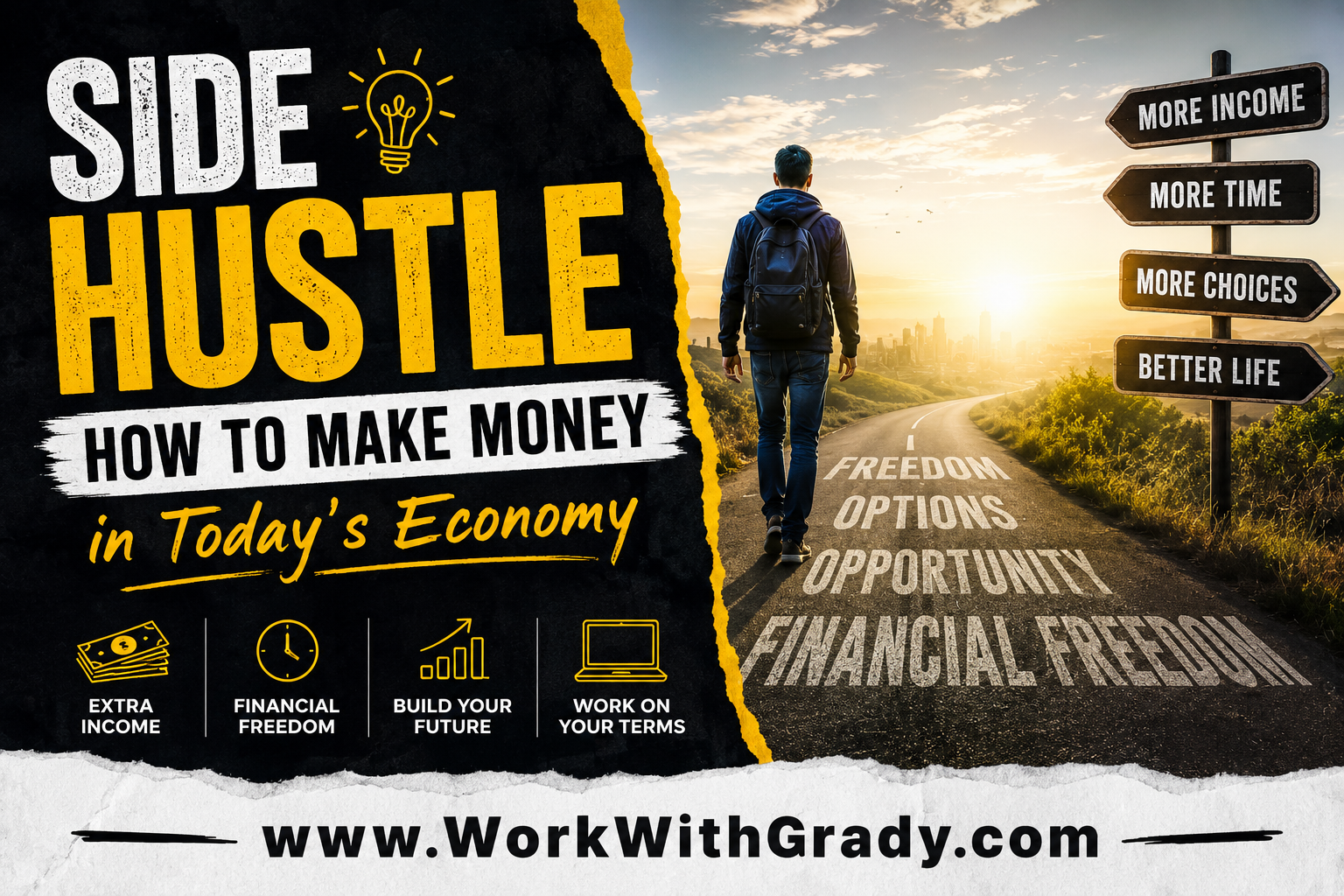
If you’ve been feeling like the economy is “fine” on paper but heavier in real life, you’re not imagining it. A side hustle matters more now than ever because higher prices, slower hiring, and uncertainty are squeezing the middle, and relying on a single income stream is a fragile strategy. In this article, I’m going to break down what’s happening in the economy right now, why free enterprise is the real path to mental freedom, and how to think about a side hustle the right way so you build leverage instead of burnout.
People argue about “the economy” like it’s one number. It isn’t. It’s a stack of pressures hitting households and small businesses at the same time.
Start with inflation. Even though it’s not at the peak levels we saw a few years back, prices are still rising faster than most people’s financial breathing room can handle. The latest U.S. CPI report shows prices up 3.8% over the last 12 months (April 2026). That’s the kind of “slow bleed” inflation that doesn’t feel dramatic in a headline, but shows up everywhere in real life, groceries, insurance, utilities, repairs, subscriptions, and the stuff that never stops. Energy, specifically, has been a major contributor recently, with the CPI energy index up 17.9% year-over-year in April.
Now layer on rates. The “easy money” era is over, and that matters because it changes behavior across the board. The Fed’s target range is currently 3.50%–3.75%, which keeps borrowing expensive and slows down parts of the economy that depend on cheap credit, housing activity, certain consumer spending, and business expansion decisions.
Employment is another example of why it feels weird. The unemployment rate isn’t screaming crisis, 4.3% in April 2026, but that doesn’t mean the labor market feels easy for everyone. Payroll growth has been modest (+115,000 in April), and when hiring is selective, people feel it in longer search timelines and slower upward mobility even if the headline number looks “fine.”
And then you’ve got the “store of value” conversation that always gets louder in environments like this. When people feel squeezed, money buying less, borrowing costing more, uncertainty staying elevated, precious metals tend to get more attention because they’re tangible and historically have been used as a hedge in uncertain times. The catch is that metals don’t live in a vacuum: higher yields can pressure non-yielding assets, and you can see that dynamic in day-to-day price swings. Recent market reporting shows gold pulling back while yields and the dollar weighed on metals, and silver moving sharply as well.
That’s the reality: people are working, doing “the responsible thing,” and still feeling tight because the margin isn’t there. When you stack persistent inflation pressure, higher-for-longer borrowing costs, and a labor market that’s stable but not “easy,” it creates a specific kind of stress, busy, but not building.
Most people think a side hustle is only about extra money. That’s true on the surface, but it’s not the biggest win. The deeper reason a side hustle matters is that it restores mental freedom and mental freedom changes how you live, how you decide, and how you show up.
When all your income comes from one place, your nervous system knows it even if you try to ignore it. You feel it as a background hum of pressure that never fully shuts off. You might be doing “fine,” but there’s a subtle tension underneath everything because your options are limited. One unexpected expense, one shift at work, one health issue, one slow season and suddenly everything feels fragile.
That fragility shows up in ways people don’t always connect to money.
It shows up when you say yes to things you don’t want to do because you “have to.” It shows up when you stay quiet in situations where you should speak up because you “can’t risk it.” It shows up when you put off health, family, and goals because you’re constantly managing the month instead of building the future. You’re not lazy, you’re living in a system where your time is your only lever, so your brain stays in maintenance mode.
A side hustle changes your psychology because it changes your options. Even a few hundred extra dollars a month can flip your internal state from panic to planning. It can turn “I hope nothing goes wrong” into “I can handle it.” It can convert survival thinking into strategy thinking. And when your nervous system stops feeling trapped, you make better decisions across the board. You stop grabbing the quickest short-term fix and start making choices that actually build momentum.
This is why people who build a side hustle often report benefits that have nothing to do with the exact number they made that month. They sleep better because the pressure dropped. They communicate better because they’re not carrying constant financial tension. They take better care of themselves because they’re not always in reaction mode. They become more decisive because they’re no longer terrified of the consequences of one wrong move.
That’s what mental freedom looks like: you move from “I’m stuck with whatever happens” to “I have leverage.”
And that’s why true free enterprise matters so much. A side hustle isn’t just “extra income.” It’s a pathway to ownership, ownership of a skill, ownership of a system, ownership of a value stream that isn’t dependent on your boss, your schedule, or your next paycheck. When you have that, your life stops feeling like it’s being managed by circumstances and starts feeling like it’s being built on purpose.
Free enterprise is still the greatest opportunity hiding in plain sight, but most people miss it because they’re looking for hype instead of value. A side hustle becomes real when it’s built on something the market actually rewards: solving a real problem, communicating that solution clearly, and using a simple system to get in front of people who already want it. That’s the whole game. Not chasing everyone. Not convincing strangers. Not trying to “go viral.” Just delivering value in a way that can be repeated.
That’s also why the internet is the most powerful leverage tool the average person has ever had access to. You can build a small audience that compounds instead of starting over every day. You can build a list you own instead of renting attention from an algorithm. You can set up follow-up that works behind the scenes so you’re not stuck living in DMs or constantly performing online. You don’t need to be famous, you don’t need to be “on” all day, and you definitely don’t need to turn your life into content. What you need is a repeatable machine that turns attention into leads, and leads into trust because trust is what converts.
The problem is most people choose the wrong kind of side hustle. They pick something that requires them to become someone they’re not. They jump into models that depend on constant posting, nonstop selling, awkward outreach, or complicated tech. For a week or two they’re excited. Then the reality hits: it’s emotionally draining, time-consuming, and inconsistent. They burn out and conclude, “Side hustles don’t work,” when the truth is simpler, the wrong model doesn’t work for them.
A smart side hustle has a different structure. It’s simple enough to execute on a normal week without your life falling apart. It has a clear path to revenue so you’re not guessing how money is made. And it compounds, meaning your work builds an asset over time, an audience, a skill, a system, a list, relationships, so results get easier instead of harder.
That’s what free enterprise is supposed to feel like. Not frantic. Not desperate. Not “hustle culture.” It should feel like you’re building leverage. You create something useful, you put it in front of the right people, and you follow up consistently enough that trust forms. When you do that, the side hustle stops being a random attempt to make extra money and becomes a real engine that can grow, without you needing to change your personality or live online 24/7.
If you want this to be real, don’t start by trying to “change your life.” That mindset usually triggers pressure, perfection, and procrastination because your brain immediately turns it into a huge project with a huge emotional cost.
Start smaller. Start smarter. Start by building a tiny free-enterprise engine that can grow.
The goal this week is simple: create a repeatable path where attention doesn’t disappear, trust gets built automatically, and money becomes a byproduct of value, not a constant chase.
Step 1: Choose one problem you can help solve (in one sentence)
This is where most people get stuck because they choose something vague like “help people grow their business” or “help people make money.” That’s not a problem. That’s a category.
A real problem is something someone is already feeling right now.
Think in terms of frustration:
“I’m getting leads, but they’re not converting.”
“I’m posting, but nothing consistent is coming from it.”
“I need extra income, but I hate selling and I’m not trying to become an influencer.”
“I keep starting things and stopping because I get overwhelmed.”
If you can write it in one sentence, you can build a message around it. If you can’t, your side hustle will stay fuzzy and you’ll keep “working” without traction.
Step 2: Create one simple free resource that solves a piece of that problem
This is your lead magnet, but don’t make it complicated. You’re not writing a book. You’re creating something that gives a quick win and builds trust.
A strong free resource does one thing: it makes the next step feel obvious.
Examples:
If the problem is “leads aren’t converting,” your free resource could be a short follow-up script, a simple 7-day email sequence, or “the 3 CTA upgrades that filter buyers.”
If the problem is “extra income without selling,” your free resource could be a checklist of simple models, a “starter plan” with a 30-minute/day routine, or a script that shows how to share an offer without pitching.
Keep it short and practical. One page is fine. Two pages is fine. A short Google Doc is fine. The point is speed to execution.
Step 3: Capture leads so attention doesn’t disappear
This is where most people stay broke online: they get attention, then lose it.
If someone likes your post today and you have no way to capture them, you’re starting over tomorrow.
So give yourself a place to send people.
It can be an opt-in page, a basic form, or even “DM me the word ___ and I’ll send it” (then you collect their email when you deliver it).
The tool doesn’t matter as much as the principle: turn attention into an asset you control.
Step 4: Follow up with value for 7 days (this is where momentum is built)
This is the part most people skip, and it’s why their side hustle never becomes stable.
A 7-day follow-up doesn’t have to be long. It just has to be consistent.
For one week, send one message per day that clarifies the real problem, teaches a simple shift, shares a quick example, answers a common objection, or invites a next step.
Don’t try to cram everything into one email. One idea per day is enough.
And yes, every email should end with a next step, but it doesn’t have to be pushy. It can be clean and simple:
“If you want help applying this, reply with ‘HELP’ and I’ll point you in the right direction.”
That’s it. Clarity beats pressure.
Step 5: Make one clear invitation at the end of the week
If you never invite people to take the next step, you’re running a charity newsletter.
At the end of the 7 days, you make a clear invitation to book a call, join the program, start the offer, or take the next action you’re building toward.
Your side hustle becomes real when you stop treating it like “content” and start treating it like a system.
Because that’s what it is: a system that creates leads, builds trust, and produces income consistently, without you needing perfect motivation or a perfect week.
That’s a side hustle built like a business.
It creates an asset, not a mood.
The economy is giving everyone the same lesson: depending on one lane is risky. When all of your income comes from one source, you don’t just feel it financially, you feel it mentally. You feel it in the background pressure, the “I can’t mess this up” energy, the hesitation to make changes, and the way life starts to feel like a constant month-to-month management game.
A side hustle isn’t a trend. It’s a decision to build options. It’s how you reclaim mental freedom, because once you can create value on demand, you stop living like your future is in someone else’s hands. You stop negotiating your dreams around “what your job allows.” You stop delaying everything until you feel safer. Options change how you think, and how you think changes how you live.
And if you want the most practical side hustle model I’ve seen work for everyday people, I’ll say it plainly: affiliate marketing is one of the smartest paths. Not because it’s “easy money,” but because it lets you earn by recommending real solutions people already want, without building a product from scratch, without managing fulfillment, and without needing to be famous. When it’s done the right way, affiliate marketing becomes a system: traffic, lead capture, follow-up, and a clear offer. That’s leverage. That’s ownership. That’s how side income becomes real income over time.
If you want to see the programs I recommend, the ones I’ve personally built with and vetted, click here to see them.
And if you want help turning this into a plan that fits your strengths, I’m offering a FREE 20-minute private coaching session (normally $333). We’ll identify the simplest side hustle path for you, tighten your message so you attract the right people, and map your next steps so you stop circling and start building.

#SideHustle, #FreeEnterprise, #PersonalDevelopment, #Entrepreneurship, #BusinessGrowth, #MakeMoneyOnline, #LeadGeneration, #EmailMarketing, #SalesFunnels, #MarketingSystems, #FinancialFreedom, #MindsetShift, #OnlineBusiness, #DigitalMarketing, #IncomeStreams
Stay ahead in a rapidly world. Subscribe to Prysm Insights,our monthly look at the critical issues facing global business.

