

- Call us
813-751-6429

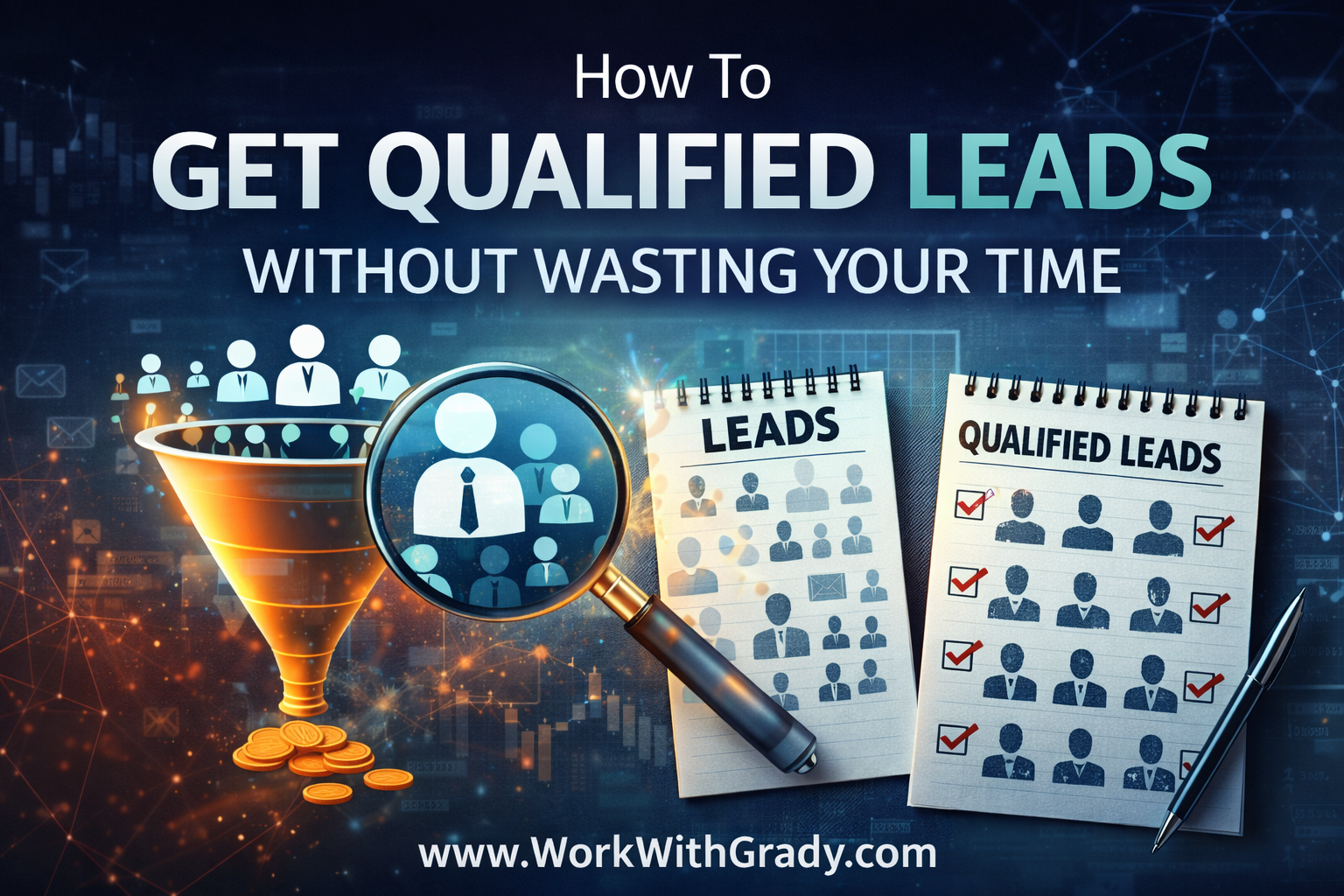
If you’re trying to get qualified leads but you keep attracting people who “love your content” and never buy, you’re not dealing with a traffic problem. You’re dealing with a filtering problem. In this article, I’m going to show you why “more leads” is often the fastest way to get more frustration, how qualified leads are created through messaging and CTAs (not luck), and how to use both organic and paid traffic to bring in buyers who are already looking for what you do.
Most business owners chase volume because it feels like progress. More views, more clicks, more DMs, more people “interested.” It gives you activity you can point to, numbers you can watch go up, and that quick hit of “something’s happening.” The problem is volume doesn’t equal revenue, and it definitely doesn’t equal peace. In fact, chasing volume without a filter usually increases stress because it multiplies noise, not sales.
Here’s what normally happens when you chase more leads without qualification: you end up in more conversations with people who can’t afford your offer, more back-and-forth with people who were never serious, and more time spent explaining basics to people who just wanted to “pick your brain.” Your calendar fills up, your inbox stays busy, and your brain stays on. But sales still come in inconsistently because the pipeline is clogged with the wrong people.
That’s the difference between leads and qualified leads. A lead is attention. A qualified lead is intent. Attention says, “I saw this.” Intent says, “I want this solved, and I’m ready to do something about it.”
And intent is what pays.
A qualified lead isn’t just someone who clicks, comments, or says they’re “interested.” A qualified lead is someone who already has three things happening internally before they ever talk to you: they have a real problem they’re willing to solve, they want a specific outcome badly enough to take action, and they believe change is possible, they’re just looking for the right path.
That last part matters.
Qualified leads don’t need to be convinced. They need clarity. They need to feel like you understand what they’re dealing with, and they need a clear next step that makes sense. When your message hits those three internal buttons, the right people lean in almost automatically, because you’re not trying to “sell” them—you’re helping them connect dots they already feel.
So why aren’t your leads qualified?
Because most marketing is written like a brochure. It leads with what you do, what you offer, and how your process works. It lists features, credentials, and descriptions that might be accurate, but miss the moment the buyer is actually in. The buyer isn’t asking, “What do you do?” They’re asking, “Is this for me, and can this help me?” If your message doesn’t answer that immediately, the prospect is forced to do mental work to connect your offer to their life.
And most people won’t do that work.
They’ll scroll. They’ll bounce. They’ll ghost. Or they’ll ask surface-level questions that go nowhere, because they were never truly qualified in the first place. The marketing didn’t filter, they just wandered in.
Qualified leads show up when your message makes people feel understood first, then shows a believable path, then gives one clear next step. Your job is not to “get everyone.” It’s to speak so specifically that the wrong people self-select out and the right people feel like you’re talking directly to them.
That’s when leads stop being random attention and start becoming real intent and intent is what turns into revenue.
If you want qualified leads, you have to stop introducing yourself with a title and start leading with the problem you solve and the outcome you create. Most business owners open their marketing the way they’d introduce themselves at a networking event: “I help business owners with marketing,” or “I’m a coach,” or “I do lead generation.” That’s technically true, but it’s not how buyers think. Buyers don’t wake up searching for a “marketer.” They wake up feeling a specific pain, like getting attention but not getting sales and they’re looking for the shortest path out of it.
That’s why the messaging shift is so powerful. The moment you move from “what I do” to “what you’re dealing with,” you stop attracting random curiosity and start attracting intent. Instead of saying, “I help business owners with marketing,” you say, “If you’re getting attention but not getting buyers, I’ll help you fix your message and follow-up so leads turn into booked calls consistently.” That one sentence does the filtering for you. The curious person who just wants to learn or browse won’t feel as connected. But the person who’s living that exact frustration will feel called out, in a good way because you just described their reality and offered a clear outcome.
Once your message is problem-and-outcome-first, your CTA becomes the gate that decides whether you get browsers or buyers.
Most people accidentally destroy lead quality by using lazy CTAs like “Let me know,” “DM me,” “Link in bio,” or “Thoughts?” Those invitations are too open, which means you get everyone: tire-kickers, broke people, indecisive people, and people who just want to talk. That’s not a lead problem, it’s a filter problem. If you want qualified leads, your CTA needs to require a small commitment that only serious people will make, and it needs to be tied to the exact problem you just described so the right person instantly knows, “This is for me.”
For example, if your message is about follow-up and conversion, your CTA shouldn’t be “DM me.” It should be something like: “If you want the exact follow-up that turns new leads into buyers, comment ‘FOLLOW-UP’ and I’ll send it.” Now you’re not begging for engagement, you’re creating a doorway. The person who walks through that doorway is raising their hand for a specific solution, which is a strong signal of intent.
You can use the same filter with decision-based language too: “If you’re ready to fix conversion this week, reply ‘READY’ and I’ll tell you the next step.” Or a fit-based CTA that pre-qualifies: “If you’re already getting leads but they’re not converting, DM me ‘CONVERT’ and I’ll ask you two quick questions to see if I can help.” The point isn’t to be clever. The point is to make the next step slightly effortful so only the right people take it.
That’s how you stop chasing leads and start attracting qualified leads, with messaging that speaks directly to a real problem and CTAs that act like a filter instead of an open invitation.
Organic content can work, but it’s slower because you’re waiting on reach and consistency. Paid traffic speeds up the process by putting your message in front of people now.
But here’s the rule: paid traffic doesn’t fix a weak message. It amplifies it.
If your message is vague, paid traffic will bring you more vague leads. If your message is sharp, paid traffic becomes a lead machine.
The paid traffic sources I recommend can work well when you already understand what you’re trying to do: drive targeted attention into a simple lead capture page, then follow up with value and a clear next step.
Here’s how to think about each one:
Udimi can be used when you have a clean opt-in that speaks to a specific pain. The win here isn’t “more clicks.” The win is building your list with people who actually want the solution you’re offering, then qualifying them through follow-up.
Perpetual Traffic works when you want consistent, scalable leads and you’re serious about systems. It’s for the person who understands that advertising is not a one-time event, it’s a process you improve.
TrafficForMe is useful if you want help getting traffic flowing without trying to become a paid ads expert overnight. The goal is still the same: traffic is only step one. The real conversion happens through the message and the follow-up.
No matter which traffic source you choose, the strategy stays the same: you’re not buying leads. You’re buying attention. Your system turns that attention into qualified leads.
If you want qualified leads, stop chasing volume and start building filters. Most businesses don’t actually have a traffic problem, they have a translation problem. Their message isn’t sharp enough to attract intent, their CTA is too open-ended to screen people, and their follow-up is too inconsistent to turn interest into trust.
When those three pieces are in place, everything gets cleaner. You stop spending your day on “maybe” people. You stop answering the same basic questions from people who were never serious.
And you stop confusing activity with progress. Instead, you start talking to people who already feel the problem, already want the outcome, and are simply looking for the right path, meaning your conversations get shorter, your close rate goes up, and your time stops getting chewed up by tire-kickers.
And if you want help building this the right way, I’m offering a FREE 20-minute private coaching session (normally $333). In that session, we’ll tighten your message so it pulls qualified leads, rebuild your CTA so it filters buyers, and map out a simple lead-to-sale flow you can run with either organic content or paid traffic, Udimi, Perpetual Traffic, and TrafficForMe, so you’re not guessing where leads should come from or what should happen after they show interest.
#QualifiedLeads, #LeadGeneration, #MarketingStrategy, #MessagingMatters, #ConversionRate, #SalesLeads, #BusinessGrowth, #PaidTraffic, #Udimi, #EmailMarketing, #SalesFunnel, #OnlineBusiness, #Entrepreneurship, #CustomerAcquisition, #MarketingSystems
Stay ahead in a rapidly world. Subscribe to Prysm Insights,our monthly look at the critical issues facing global business.

