

- Call us
813-751-6429

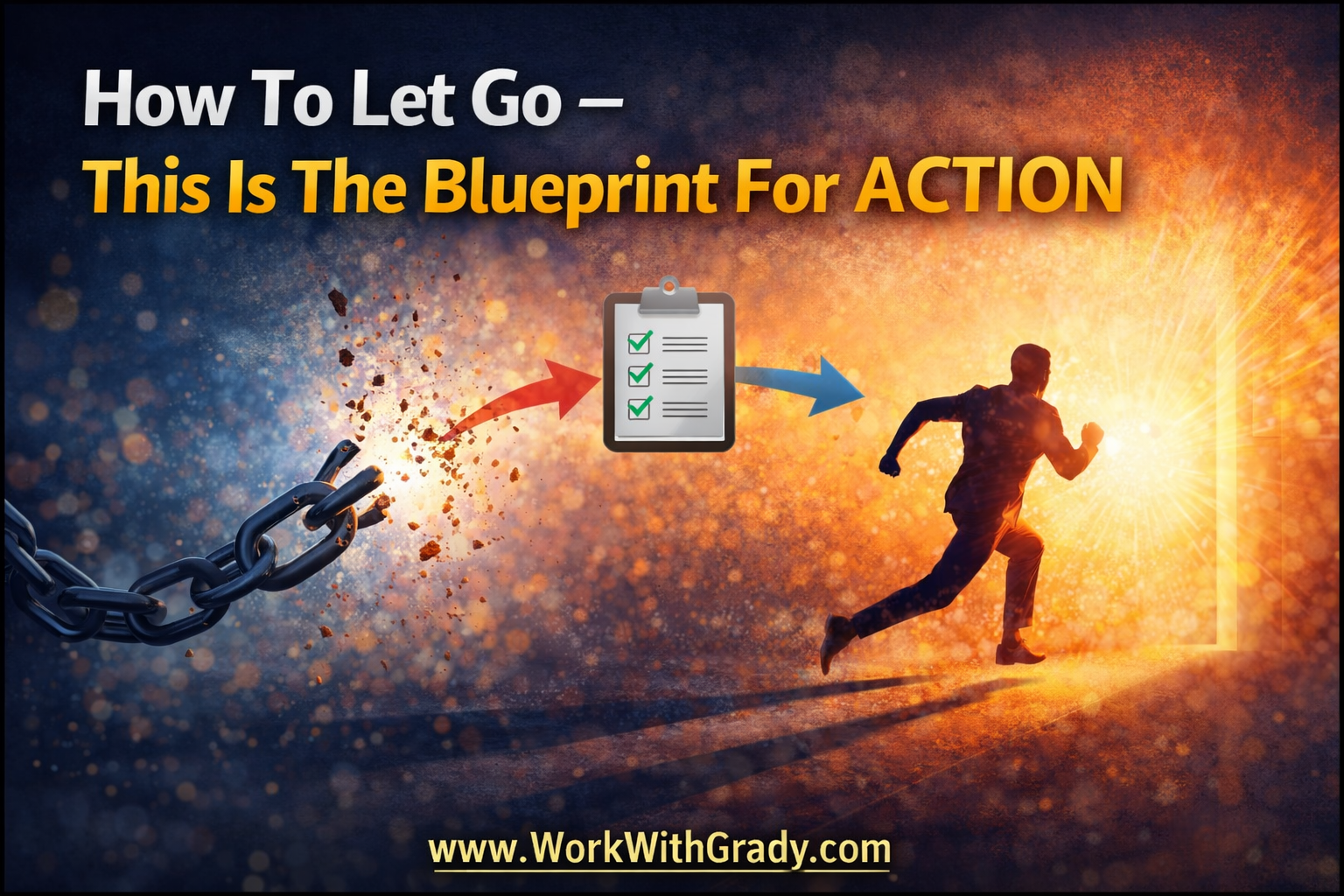
If you’ve been searching for how to let go and take action, you’re probably in a familiar place. You know what you should do, you can feel what needs to change, and you may even have moments of clarity, but you still don’t move. You hesitate, overthink, and wait for the “right time.” Then you get frustrated with yourself because the desire is real, but the follow-through isn’t. This article will show you how to let go and take action without forcing fake confidence or waiting for fear to disappear. You’re going to understand what you’re actually holding onto, why the mind negotiates instead of moving, and how to release the internal resistance that keeps action feeling heavier than it needs to be.
Most people believe they’re holding onto a situation, a person, a job, or a habit. But what they’re really holding onto is the emotional safety that comes from familiarity. Even when something is painful, it can still feel “safe” because it’s predictable. The brain and nervous system often prefer known discomfort over unknown possibility, because unknown outcomes trigger uncertainty, and uncertainty is often processed like threat. This is one of the biggest reasons people stay stuck in cycles they openly say they want to escape. It is not because they enjoy the struggle. It is because letting go feels like stepping into something undefined, and the nervous system treats undefined as dangerous until it learns otherwise.
When you understand this, the problem stops being mysterious. You stop judging yourself for hesitating and start seeing the real mechanism. Learning how to let go and take action is, at its core, learning how to stop treating uncertainty like danger and how to build the internal stability required to move forward even when you can’t predict every outcome.
A major reason people don’t move is because they keep negotiating with themselves. They try to make action feel comfortable before they take it. They want confidence first, motivation first, clarity first, and a guarantee that it will work before they do anything that could expose them to discomfort. But confidence does not come before action. Confidence is the result of action taken repeatedly. Momentum does not appear because you think about it. Momentum shows up because you move, and the motion creates proof. If you wait to feel ready, you will stay stuck in the loop of preparation, because readiness is often just fear asking for more time.
If you want to know how to let go and take action, you have to stop asking, “How do I feel ready?” and start asking, “What is one small step I can take even if I’m not ready?” Action is not a mood. Action is a decision. And the decision becomes easier when you stop demanding emotional certainty before you allow yourself to move.
Fear is not always a warning sign that you are doing something wrong. Often, fear is simply a signal that you are stepping outside of the familiar. The goal is not to eliminate fear. The goal is to stop giving fear the final vote. When you feel fear and you back away, your nervous system learns a pattern: fear means stop. Over time, hesitation becomes automatic. Your brain starts associating forward movement with danger even when the action is healthy, necessary, and aligned with who you want to become.
When you feel fear and take action anyway, your nervous system learns something different. It learns that fear can be present and survivable at the same time. It learns that discomfort does not equal catastrophe. You gain evidence. And evidence is what builds self-trust. Self-trust is what creates momentum. This is why the real skill behind how to let go and take action is emotional regulation, not motivation. Motivation comes and goes. Regulation builds stability.
Letting go is rarely about the thing itself. It is about what you believe that thing protects you from. People cling to comfort because discomfort feels unsafe. They cling to control because uncertainty feels threatening. They cling to perfection because judgment feels unbearable. They cling to endless planning because failure feels like identity death. They cling to old identities because change requires leaving familiar versions of themselves behind. In each case, the attachment is not random. It’s protective. The cost is that life becomes a waiting room, where you keep telling yourself you will move when you feel different, when circumstances change, or when timing improves.
But the truth is that timing is rarely the problem. Internal attachment is the problem. If you want to learn how to let go and take action, you have to tell the truth about what you’re clinging to and why, because the truth is what breaks the spell. Most people are not stuck because they can’t act. They are stuck because they haven’t decided to release the old story that says, “If I move, something bad will happen.”
If you want to shift this quickly, stop treating your life like one massive problem and choose one specific action you have been delaying. Make it concrete. It could be a conversation you’ve avoided, a decision you’ve postponed, a habit you keep promising to start, or a task you keep overthinking. Then ask yourself a direct question: “What am I afraid will happen if I do this?” Most people are not afraid of the action itself. They are afraid of the emotional outcome they imagine will follow, such as rejection, embarrassment, disappointment, or being exposed.
Once you identify the fear, shrink the action until it no longer feels like a threat. You do not need a dramatic leap. You need a step that creates motion. Your mind may try to argue that the step is too small to matter, but that is the ego talking. The goal is not intensity. The goal is momentum. Finally, take the step immediately, before your mind rebuilds the old story and talks you out of it. This is how to let go and take action in real life. It is not mystical. It is mechanical. Movement creates proof, and proof creates change.
Most people unconsciously think letting go means losing something. In reality, letting go is how you regain your power. When you let go of the need to control every outcome, you gain clarity. When you let go of perfection, you gain speed. When you let go of old identities, you gain freedom. When you let go of fear-based thinking, you gain options. Letting go is not weakness. It is strength. It is the moment you stop living in reaction and start living in intention.
The people you admire are not fearless. They have simply learned how to move without needing guarantees. They have learned how to act while uncertainty exists. That ability is not a personality trait. It is a skill, and it is built through repetition.
If you want to know how to let go and take action, you have to stop waiting for your emotions to cooperate. You have to stop trying to think your way into confidence, and you have to stop negotiating with the same fear-based patterns that have been keeping you stuck. Letting go is the decision to stop carrying what weighs you down mentally and emotionally. Taking action is the decision to move anyway, even when uncertainty is still present.
You do not need a perfect plan. You do not need the fear to disappear. You do not need to feel “ready.” What you actually need is one aligned decision followed by one real step, because momentum is not something you find. It’s something you create. And once you create it, your nervous system starts learning a new truth: you can handle discomfort, you can move forward, and you can trust yourself again.
That is why the moment you stop holding on is the moment you finally move forward, and the moment you finally move is the moment your life starts changing for real.
And if you want help applying this in your real life, not as a concept, but as a practical shift you can feel immediately, I’m offering a FREE 20-minute private coaching session (normally $333). In that session, we’ll pinpoint exactly what you’re holding onto, identify the internal pattern blocking your action, and build a simple next-step plan that gets you moving without overwhelm.
Click Here To Schedule Your FREE 20-Minute Coaching Session
Because letting go isn’t about losing something. It’s about getting your power back.
#HowToLetGoAndTakeAction, #LetGoAndTakeAction, #PersonalDevelopment, #SelfMastery, #TakeAction, #MindsetShift, #EmotionalResilience, #Overthinking, #BreakThePattern, #InnerWork, #Confidence, #Discipline, #Consistency, #LifeTransformation, #HighPerformance
Stay ahead in a rapidly world. Subscribe to Prysm Insights,our monthly look at the critical issues facing global business.

