- Call us
813-751-6429

Most people were never taught how money truly works, not in school, not in college, and often not even at home. That’s why financial education is one of the most important subjects you’ll ever study.
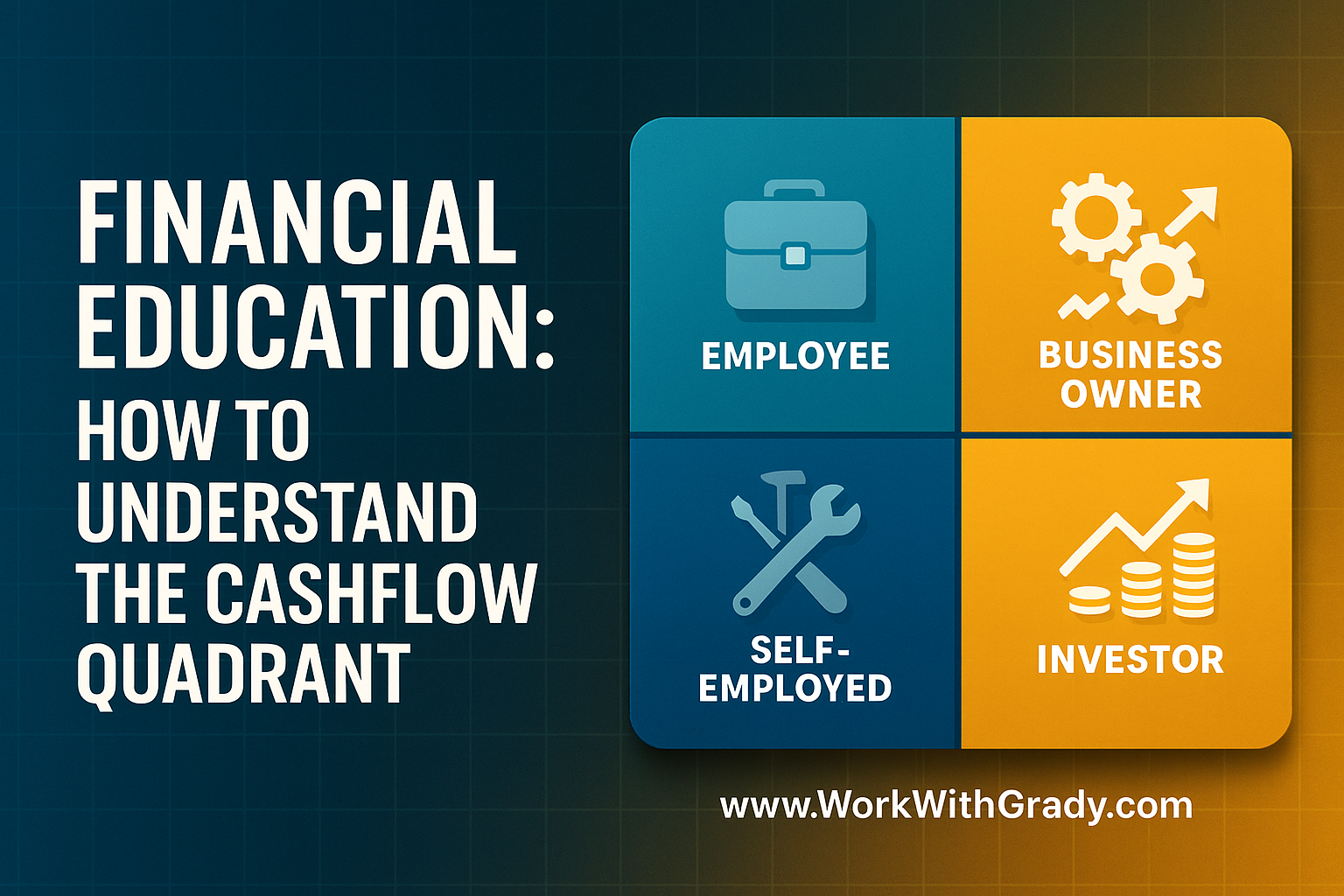
In this article, we’ll break down a simple visual, the Cashflow Quadrant and explain why understanding it can completely change your financial future.
Robert Kiyosaki, author of Rich Dad Poor Dad, introduced the Cashflow Quadrant to illustrate how people earn money and why some achieve financial freedom while others remain trapped in the grind.
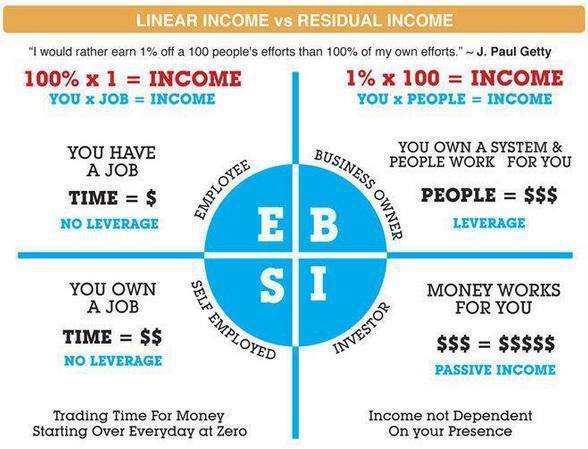
The quadrant is divided into four sections: E, S, B, and I, each representing a different way people generate income.
“You have a job.”
This is where the majority of people start and stay, because it’s what society trains us to do. From childhood, we’re told to go to school, get good grades, find a stable job, and work hard until retirement. It sounds safe, but in reality, it’s the most limited financial position of all four quadrants.
As an employee, you’re trading time for money. Every paycheck you receive is directly tied to your presence and performance. If you stop working, the money stops flowing. This is called linear income, 100% effort equals 100% income, but there’s zero leverage. Your time becomes your ceiling.
The challenge is that your financial growth is controlled by someone else’s decisions, your boss, the company, or the market. You can work harder, but you’re still limited by the hours in your day and the value someone else places on your time. Even promotions or raises rarely outpace inflation or rising living costs.
Financial education reveals a hard truth..
A job provides short-term security, not long-term freedom.
You might have benefits, steady pay, and predictability, but you also have dependency. The moment your company restructures, automates, or downsizes, your income vanishes overnight. That’s why most employees live paycheck to paycheck, even with decent salaries, their money stops the second they do.
To move beyond this quadrant, you have to shift from asking, “How can I make more money?” to “How can I create more leverage?”
Leverage comes from systems, skills, and ownership, not just hours worked.
The E quadrant is not “bad”; it’s just the starting point. Everyone begins here, but staying here forever means trading freedom for comfort. True financial education starts when you realize that working harder for someone else’s dream will never create your own.
“You own a job.”
At first glance, this quadrant looks like freedom. You’ve escaped the boss, you call the shots, and your income is based on your own effort and skill. For many, it feels like the dream, independence, flexibility, and control. But as financial education teaches us, this quadrant still comes with invisible chains.
Self-employed people often exchange one boss for many. Instead of reporting to a manager, they report to clients, deadlines, and constant demand. They may earn more than employees, but they still trade time for money, and their income depends entirely on their personal output.
Doctors, lawyers, real estate agents, consultants, freelancers, and small business owners often fall into this category. They may technically “own” their work, but their business owns their time. When they stop working, so does their income. Vacations become lost revenue. Sick days feel expensive. Retirement? Often delayed indefinitely.
Financial education exposes this hidden trap: being self-employed doesn’t automatically mean being financially free. You can have more autonomy yet still lack leverage. The moment your presence is required to make money, your business becomes another version of a job.
There’s also another layer of pressure here, the illusion of control. Self-employed individuals believe they’re fully in control, but in reality, they’re often controlled by market demand, client expectations, and burnout. When you’re the brand, the product, and the service provider, there’s little room for rest or scaling.
Many people in this quadrant work harder than employees, longer hours, more stress, and higher risk, all while believing they’re “free.” But as Robert Kiyosaki often says, “If your income stops when you stop, you don’t own a business, you own a job.”
Financial education teaches us that the goal isn’t to stay self-employed forever, it’s to use your skills, experience, and income from this stage to transition into the next quadrants: Business Owner (B) or Investor (I). Those are the levels where true freedom begins, where systems and money start working for you instead of the other way around.
The self-employed quadrant is a powerful stepping stone. It’s where you learn discipline, accountability, and how to create value. But without leverage, people, systems, or automation, it’s a cycle of high effort and limited scalability.
The key takeaway?
Don’t stop here. Use your experience as a self-employed professional to build something bigger, a system that works when you don’t.
“You own a system, and people work for you.”
This is the quadrant where financial education begins to transform into true leverage and freedom. It’s the difference between working hard for money and building something that works hard for you.
Business owners don’t just create jobs, they create systems. Instead of relying on their own time and effort, they design processes, automation, and teams that generate results with or without them. Their income is no longer limited by the hours in a day, because they’ve learned to multiply their efforts through people and systems.
This is where the concept of leverage becomes real. Instead of earning 100% of your own effort, you can earn 1% of 100 people’s efforts, a model that scales infinitely. This is what J. Paul Getty meant when he said, “I’d rather earn 1% of 100 people’s efforts than 100% of my own.”
In the B quadrant, the focus shifts from personal production to process management and leadership. Business owners think in terms of systems, not shifts. They ask, “How can this run without me?” instead of “How much more can I do myself?”
Through financial education, business owners understand that real wealth is built through duplication. They know how to create training, automation, and accountability structures so that every person in the system contributes to a larger outcome. Whether it’s a network marketing team, an online business with automated funnels, or a franchise operation, the principle remains the same: you own the system, and the system produces income.
This is also where residual income begins to flourish. A well-structured business can continue generating revenue long after the initial work is done, through recurring customers, subscription models, or automated sales funnels.
For example, imagine creating a product, course, or service once, and having it sell hundreds of times without manual effort. That’s the power of automation, and it’s what separates true entrepreneurs from self-employed individuals.
But there’s another layer of the B quadrant that often gets overlooked, mindset. Business owners must evolve from “doing everything themselves” to “trusting others to do it better.” It requires leadership, vision, and letting go of control. That’s not easy for everyone, but it’s essential for freedom.
In my own experience, this is where everything changed. When I stopped trying to be the worker in my business and instead became the architect of systems, my income multiplied and my time freedom expanded. That’s the beauty of leverage, your results compound even when you’re not physically present.
Financial education teaches you how to transition into this mindset, how to delegate, systemize, and automate. It’s not about building a job; it’s about building a machine that runs itself.
The B quadrant represents the bridge between working for money and building generational wealth. It’s where you create something that lasts, a system that supports others, provides value, and continues growing long after you’ve stepped away from the day-to-day operations.
This is the beginning of true financial freedom.
“Money works for you.”
This is the final quadrant and the one where true financial freedom begins. The Investor quadrant is where your money becomes your employee. Every dollar you earn is sent out to work, bringing back more dollars in return. It’s not about trading time for money anymore, it’s about building systems of wealth that continue to grow whether you’re awake, asleep, or halfway around the world.
Investors don’t rely on labor or luck; they rely on leverage, timing, and informed decision-making. This is where financial education shows its ultimate value, because without knowledge, investing turns into gambling. But with education, it becomes the gateway to financial independence.
The investor’s mindset is simple…
“If my money isn’t working, I’m working too hard.”
Here, income is generated from assets, not activity. Stocks, real estate, dividends, royalties, private equity, business ownership stakes, or passive cash-flowing ventures, each one produces residual income that compounds over time. The wealthy operate here because they’ve learned how to make their money work harder than they do.
Unlike employees or self-employed individuals, investors understand the power of compound growth. Albert Einstein called it the “eighth wonder of the world.” When you reinvest your earnings, your money doesn’t just grow, it multiplies exponentially. One dollar can become two, then four, then eight, not because you worked more hours, but because you worked smarter with your money.
This quadrant is also where risk and reward are redefined. The uneducated see investing as risky; the financially educated see ignorance as the real danger. Knowledge minimizes risk. When you understand markets, trends, and asset cycles, you move from guessing to strategizing. You begin to make decisions based on logic, data, and long-term value, not emotion.
Financial education is the bridge that gets you here. It teaches you the language of wealth, how to read financial statements, understand tax advantages, leverage debt strategically, and identify assets that produce consistent returns. Once you master that, you’re no longer dependent on a paycheck, a boss, or even your own labor.
The Investor quadrant represents freedom of time and choice. You no longer have to ask, “Can I afford this?” but instead, “Does this align with my values and vision?” You’re not working to survive, you’re investing to thrive, to build a legacy, and to create generational wealth that continues long after you’re gone.
In short, employees work for money, self-employed work harder for themselves, business owners build systems that work for them.
But Investors? They make money work FOR them, endlessly, efficiently, and intelligently.
That’s the ultimate goal of financial education: to move from trading time for dollars to owning the systems, assets, and investments that compound wealth for life.
Most people spend their entire lives on the left side of the quadrant, the E (Employee) and S (Self-Employed) side, where time equals money and income depends on constant effort. They work harder, longer, and often smarter, but still remain trapped in a system that rewards activity more than results. Their income resets every Monday morning because it’s built on labor, not leverage.
But those who break free, the Business Owners and Investors, understand a different truth: wealth isn’t built by working harder; it’s built by creating leverage. They learn to use systems, people, and capital to generate income that flows even when they’re not working. That’s the difference between linear income and residual income, one stops when you stop, the other compounds whether you’re active or not.
This is the essence of financial education. It teaches you how to make your money work for you instead of you constantly working for it. It shows you that success isn’t about endless hustle, it’s about building structures that pay you long after the work is done.
Unfortunately, most people were taught an outdated model, “Go to school. Get a good job. Work hard. Retire at 65.”
That system no longer works in today’s economy. Inflation rises faster than wages. Job security is an illusion. And retirement plans rarely provide true freedom. Without financial education, most people end up in a cycle of work, spend, owe, repeat, wondering why their effort never leads to stability.
But once you understand how to move from linear income to residual income, everything changes. You begin to build systems that continue paying you long after you’ve done the work, create assets, not liabilities, and multiply your income instead of trading hours for dollars.
That’s when freedom becomes possible, not someday, but starting now.
I’ve lived both sides of this equation.
I started like most people, trading time for money, working long hours, and believing effort alone would equal success. But once I learned the principles of financial education, everything changed.
I began to understand how money really moves, how systems multiply results, and how automation and leverage can turn effort into exponential growth. I built systems, created multiple streams of income, and learned to let my business work for me instead of the other way around.
Now, my mission is to help others make that same shift, from employee or self-employed… to business owner and investor. Because once you learn how money truly works, you’ll never see the world the same way again.
If you’re ready to make that transition, I want to help you personally.
I’m offering a FREE 20-minute coaching session (valued at $175) where I’ll walk you through exactly how to create leverage through systems and automation, build your own path to residual income, and move strategically from the left side of the quadrant to the right, from time-based income to freedom-based wealth.

Because when you truly understand financial education, you stop chasing money and money starts chasing you.
Click here to book your FREE 20-minute session today and begin your journey toward financial independence.
#FinancialEducation, #CashflowQuadrant, #FinancialFreedom, #WealthBuilding, #PassiveIncome, #ResidualIncome, #Entrepreneurship, #Investing, #SuccessMindset, #WorkFromHome
Stay ahead in a rapidly world. Subscribe to Prysm Insights,our monthly look at the critical issues facing global business.